
COLOUR VISION DISORDERS
Colour recognition plays a fundamental role in the way we interpret images and interact with the world (1-3). From recognising traffic signals and interpreting maps, to identifying ripe produce, appreciating artwork and distinguishing subtle visual cues within the workplace, colour vision contributes to countless aspects of daily life (3). Whilst many individuals rarely consider how colour perception influences their visual experience, variations in colour vision are relatively common and may have important implications for education, career planning and occupational performance.
Colour vision deficiency, often referred to as colour blindness, affects approximately 8% of males and less than 1% of females of Northern European ancestry, making it one of the most common inherited visual conditions worldwide(1,2). Most colour vision deficiencies are present from birth and result from alterations in the cone photoreceptors responsible for detecting different wavelengths of light (3-4). Less commonly, colour vision abnormalities may develop later in life as a consequence of ocular disease, neurological conditions, medication effects or other acquired disorders affecting the visual system(6-8).
-
The human retina contains around 5 million specialised photoreceptor cells known as cones, which enable the perception of colour (9). Three different cone populations are sensitive to short, medium and long wavelengths of light (roughly corresponding to blue, green and red resepctively), allowing the brain to interpret a broad spectrum of colours through comparison of signals from these cells (10). Variations in the number, function or sensitivity of these photoreceptors can significantly alter colour discrimination, resulting in differing degrees of colour vision deficiency (11, 12).
Contrary to popular belief, the vast majority of individuals with colour vision deficiency do not see the world in black and white. Rather, certain colours may appear more similar to one another, making discrimination between specific shades more challenging. Red-green colour vision deficiencies (Deuteranomaly, Deuteranopia,Protanomaly, and Protanopia) are the most common, whilst blue-yellow deficiencies (Tritanomaly or Tritanopia) and complete colour vision loss (Rod monochromatism) are considerably less frequent(12-14). The extent to which colour vision deficiency affects daily activities varies substantially between individuals, with many people adapting remarkably well and remaining unaware of their condition until formal testing is performed.
For children, colour vision deficiency may influence classroom experiences in subtle ways. Educational materials frequently rely upon colour coding, and difficulties distinguishing particular colours can occasionally affect learning activities, interpretation of charts or participation in colour-based tasks. Early identification allows parents and educators to better understand a child's visual experience and implement simple adjustments where necessary.
For adults, colour vision can be an important consideration in occupational settings. Certain professions require accurate colour discrimination for safety, diagnostic accuracy or operational performance. Aviation, rail transport, electrical trades, emergency services, defence, maritime occupations and some scientific or technical professions may incorporate colour vision standards as part of their recruitment or ongoing certification processes(4, 15). Understanding colour vision status early can assist individuals in making informed educational and career decisions, reducing the likelihood of unexpected barriers later in life.
Importantly, colour vision deficiency should not be viewed as a limitation upon achievement or potential. Individuals with colour vision deficiency contribute successfully across virtually every profession and area of society. Awareness of one's colour vision status simply provides valuable information regarding how visual information is perceived and whether any accommodations or occupational considerations may be beneficial.
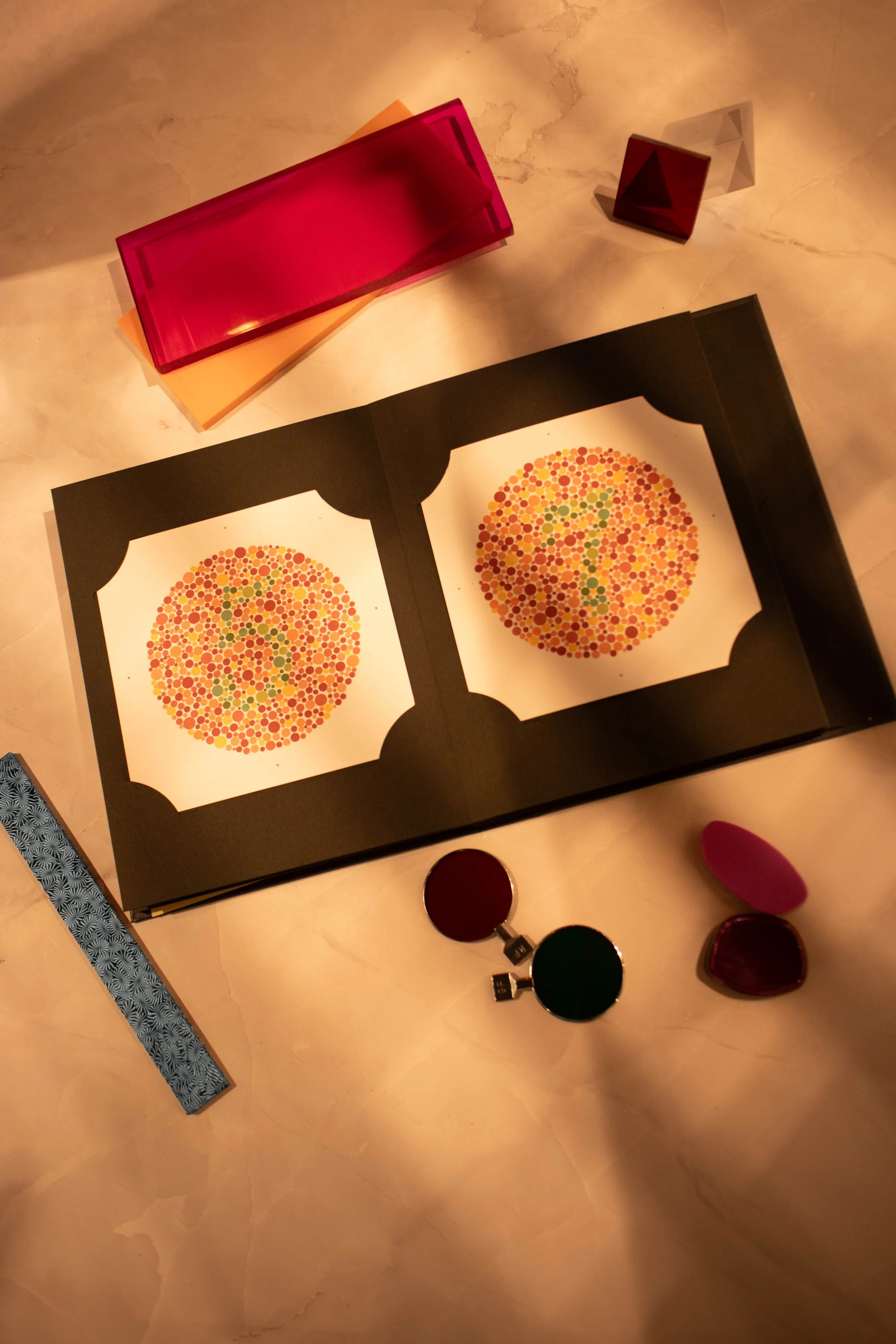
At Onèj Optometry, colour vision assessment forms part of a comprehensive evaluation of visual function. Testing may be performed for educational purposes, occupational requirements, pre-employment screening, licensing assessments or investigation of suspected ocular disease. Ishihara colour plates are commonly used to identify the presence of red-green colour vision deficiencies, whilst more advanced testing such as the Farnsworth D15 colour arrangement test allows further assessment of colour discrimination and classification of colour vision defects. Together, these assessments provide a more detailed understanding of an individual's colour perception and visual capabilities.
At Onèj Optometry, our approach extends beyond simply identifying whether a colour vision deficiency is present. We believe that understanding visual strengths and limitations empowers individuals to make informed decisions regarding education, career pathways and visual health. Through comprehensive assessment, clear explanation of findings and personalised advice, we aim to provide patients with meaningful insight into how they experience the visual world.When required, onward referral for further analysis of colour vision limitations can be arranged.
References
Bosten, J. M. (2022). Do you see what I see? Diversity in human color perception. Annual review of vision science, 8, 101-133.
Hiramatsu, C., Takashima, T., Sakaguchi, H., Chen, X., Tajima, S., Seno, T., & Kawamura, S. (2023). Influence of colour vision on attention to, and impression of, complex aesthetic images. Proceedings of the Royal Society B: Biological Sciences, 290(2006), 20231332.
Cole, Barry L. "The handicap of abnormal colour vision." Clinical and Experimental Optometry 87, no. 4-5 (2004): 258-275.
Cumberland, P., Rahi, J. S., & Peckham, C. S. (2005). Impact of congenital colour vision defects on occupation. Archives of disease in childhood, 90(9), 906-908.
Cole, B. L. (2007). Assessment of inherited colour vision defects in clinical practice. Clinical and experimental optometry, 90(3), 157-175.
Bayer, L., Funk, J., & Töteberg-Harms, M. (2020). Incidence of dyschromatopsy in glaucoma. International ophthalmology, 40(3), 597-605.
Vandenbroucke, T., Buyl, R., De Zaeytijd, J., Bauwens, M., Uvijls, A., De Baere, E., & Leroy, B. P. (2015). Colour vision in Stargardt disease. Ophthalmic research, 54(4), 181-194.
Piro, A., Tagarelli, A., Nicoletti, G., Scannapieco, S., Polidoro, S., Valentino, P., & Quattrone, A. (2019). Impairment of acquired color vision in multiple sclerosis: an early diagnostic sign linked to the greatness of disease. International ophthalmology, 39(3), 671-676.
Lamb, T. D. (2016). Why rods and cones?. Eye, 30(2), 179-185.
Fu, Y. (2018). Phototransduction in rods and cones. In Webvision: The Organization of the Retina and Visual System [Internet]. University of Utah Health Sciences Center.
Aboshiha, J., Dubis, A. M., Carroll, J., Hardcastle, A. J., & Michaelides, M. (2016). The cone dysfunction syndromes. British Journal of Ophthalmology, 100(1), 115-121.
Hasrod, N., & Rubin, A. (2016). Defects of colour vision: A review of congenital and acquired colour vision deficiencies. African Vision and Eye Health, 75(1), 1-6.
Steward, J. M., & Cole, B. L. (1989). Incidence of congenital colour vision defects in an Australian optometric population. In Colour Vision Deficiencies IX: Proceedings of the ninth symposium of the International Research Group on Colour Vision Deficiencies, held at St. John’s College, Annapolis, Maryland, USA, 1–3 July 1987 (pp. 109-111). Dordrecht: Springer Netherlands.
Masood, Tanvir, Masarat Nazeer, Sabahat Farooq, and Sheikh Mohd Saleem. "International Journal of Current Advanced Research." (2017).
Barbur, J. L., & Rodriguez-Carmona, M. (2017). Colour vision requirements in visually demanding occupations. British medical bulletin, 122(1), 51-77.