
GLAUCOMA
Vision is fundamental to independence, productivity, mobility, social engagement, safety and quality of life (1-3). However, damage to the visual system from ocular disease can be difficult to recognise, or completely asymptomatic, in its earliest stages (4,5). Glaucoma is a group of chronic optic neuropathies that progressively damage the optic nerve, the structure responsible for transmitting visual information from the eye to the brain (6,7). Because this damage often develops slowly and without noticeable symptoms, glaucoma is frequently referred to as the "silent thief of sight"(8, 9).
Glaucoma is one of the leading causes of irreversible blindness worldwide(10). While diverse and clinically proven treatments allow patients to preserve remaining optic nerve structure and function effectively, any vision already lost to glaucoma cannot be restored using current interventions (11-16). For this reason, regular eye examinations with advanced imaging are vital to ensuring the early detection of glaucoma. Once diagnosed with glaucoma, a thorough explanation of the condition by an eyecare professional, close management to optimise treatment, and ongoing monitoring for progression are critical. At Onèj Optometry, our optometrist has extensive experience in the diagnosis and treatment of glaucoma, and is therapeutically qualified to co-manage glaucoma with ophthalmology colleagues.
-
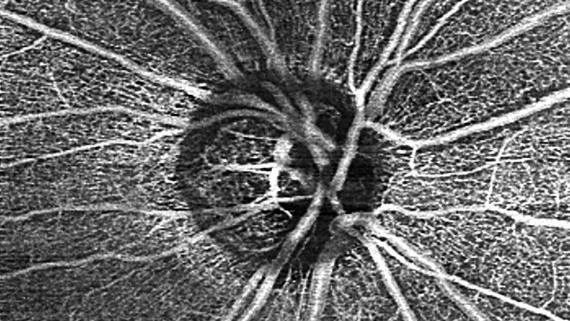
The optic nerve contains more than one million nerve fibres that collectively transmit visual information from the retina to the brain (17). In glaucoma, progressive loss of these nerve fibres results in gradual deterioration of the visual field (6,8,9,10). Early damage often subtly affects the mid- peripheral or peripheral vision, and may not be noticed in everyday life. If left undiagnosed and untreated,disease progression can damage increasingly larger areas of the visual field, causing significant implications for everyday tasks such as driving (18). Untreated glaucoma can also compromise central vision, which has a substantial impact upon performance of daily tasks, independence and mental wellbeing (1,2,18). The good news is that most cases of glaucoma can be extremely well managed in a way that preserves vision and has a minimal impact on quality of life.
One of the challenges associated with glaucoma is that significant structural damage may occur before symptoms become apparent. Many patients maintain excellent visual acuity and remain unaware of any visual difficulties during the early stages of disease. Consequently, comprehensive eye examinations play a vital role in identifying glaucoma before meaningful vision loss occurs. Individuals with a family history of glaucoma, elevated intraocular pressure, advancing age, diabetes, cardiovascular disease, high myopia, African ancestry or certain systemic health conditions may be at increased risk and should undergo regular ocular assessment(3-5).
The diagnosis and monitoring of glaucoma require careful evaluation of both the structure and function of the visual system. Structural assessment focuses upon identifying changes to the optic nerve and retinal nerve fibre layers, whilst functional assessment evaluates the impact of disease upon the visual field (5,14,19). Because glaucoma progresses differently between individuals, repeated measurements over time are often required to accurately determine whether disease is present and whether progression is occurring.
At Onèj Optometry, comprehensive glaucoma assessment incorporates detailed examination of the optic nerve, measurement of intraocular pressure, evaluation of individual risk factors and advanced ocular imaging. Optical coherence tomography (OCT) enables highly detailed assessment of the retinal nerve fibre layer and optic nerve structures, facilitating the detection of subtle changes that may precede measurable vision loss. Ultrawide retinal imaging with the Eidon system allows comprehensive documentation and assessment of retinal and optic nerve health, whilst visual field analysis with contemporary VR headset technology provides valuable information regarding the functional performance of the visual system. Together, these technologies assist in building a thorough understanding of both current ocular health and future risk.
We are committed to identifying glaucoma at its earliest possible stages, explaining findings clearly and supporting patients throughout their care journey. We work collaboratively with ophthalmologists, general practitioners and other healthcare professionals to ensure coordinated and evidence-based management. Through comprehensive examination, advanced imaging and personalised risk assessment, it is often possible to detect disease before noticeable vision loss occurs, providing the greatest opportunity to preserve vision and maintain quality of life for years to come.
References
Aartolahti, E., Häkkinen, A., Lönnroos, E., Kautiainen, H., Sulkava, R., & Hartikainen, S. (2013). Relationship between functional vision and balance and mobility performance in community-dwelling older adults. Aging clinical and experimental research, 25(5), 545-552.
Gallagher, B., & Jackson, J. (2012). Ageing and the impact of vision loss on independent living and mobility. Optometry in Practice, 13(2), 45-54.
Thorslund, B., & Strand, N. (2016). Vision measurability and its impact on safe driving: a literature review. Scandinavian Journal of Optometry and Visual Science, 9(1), 1-9.
Irving, E. L., Harris, J. D., Machan, C. M., Robinson, B. E., Hrynchak, P. K., Leat, S. J., & Lillakas, L. (2016). Value of routine eye examinations in asymptomatic patients. Optometry and Vision Science, 93(7), 660-666.
Umapathi, R. M., Hliang, T. N., Koh, A. S. M., Sim, C., Perera, S. A., Husain, R., ... & Nongpiur, M. E. (2025). Characteristics of eyes with asymptomatic primary angle closure glaucoma with varying severity of visual field loss at presentation. Journal of Glaucoma, 34(5), 358-364.
Danesh-Meyer, H. V., & Levin, L. A. (2015). Glaucoma as a neurodegenerative disease. Journal of Neuro-Ophthalmology, 35, S22-S28.
Hoang, T. T., Van Anh, B., & Subramanian, P. (2024). Is glaucoma a two-pressure-related optic neuropathy? A systematic review and meta-analysis. Turkish Journal of Ophthalmology, 54(2), 83.
Consoli, D., & Ramlogan, R. (2015). Glaucoma: The silent thief of sight. In Medical innovation (pp. 142-163). Routledge.
Odigie, I. C. (2024). Understanding “The Silent Thief of Sight”: a Review of the Causes, Diagnosis, Management and Impact of Glaucoma on Quality of Life.
Jayaram, H., Kolko, M., Friedman, D. S., & Gazzard, G. (2023). Glaucoma: now and beyond. The Lancet, 402(10414), 1788-1801.
Leske, M. C., Heijl, A., Hussein, M., Bengtsson, B., Hyman, L., Komaroff, E., & Early Manifest Glaucoma Trial Group. (2003). Factors for glaucoma progression and the effect of treatment: the early manifest glaucoma trial. Archives of ophthalmology, 121(1), 48-56.
Anderson, D. R. (2003). Collaborative normal tension glaucoma study. Current opinion in ophthalmology, 14(2), 86-90.
Nouri-Mahdavi, K., Hoffman, D., Coleman, A. L., Liu, G., Li, G., Gaasterland, D., & Caprioli, J. (2004). Predictive factors for glaucomatous visual field progression in the Advanced Glaucoma Intervention Study. Ophthalmology, 111(9), 1627-1635.
Cvenkel, B., & Kolko, M. (2020). Current medical therapy and future trends in the management of glaucoma treatment. Journal of Ophthalmology, 2020(1), 6138132.
Tanner, L., Gazzard, G., Nolan, W. P., & Foster, P. J. (2020). Has the EAGLE landed for the use of clear lens extraction in angle-closure glaucoma? And how should primary angle-closure suspects be treated?. Eye, 34(1), 40-50.
Gazzard, G., Konstantakopoulou, E., Garway-Heath, D., Adeleke, M., Vickerstaff, V., Ambler, G., ... & Zhu, H. (2023). Laser in glaucoma and ocular hypertension (LiGHT) trial: six-year results of primary selective laser trabeculoplasty versus eye drops for the treatment of glaucoma and ocular hypertension. Ophthalmology, 130(2), 139-151.
Cen, L. P., Park, K. K., & So, K. F. (2023). Optic nerve diseases and regeneration: How far are we from the promised land?. Clinical & experimental ophthalmology, 51(6), 627-641.
Latif, K., Nishida, T., Moghimi, S., & Weinreb, R. N. (2023). Quality of life in glaucoma. Graefe's Archive for Clinical and Experimental Ophthalmology, 261(10), 3023-3030.
Heijl, A., Peters, D., & Bengtsson, B. (2023). Long-term impact of immediate versus delayed treatment of early glaucoma: results from the Early Manifest Glaucoma Trial. American Journal of Ophthalmology, 252, 286-294.